
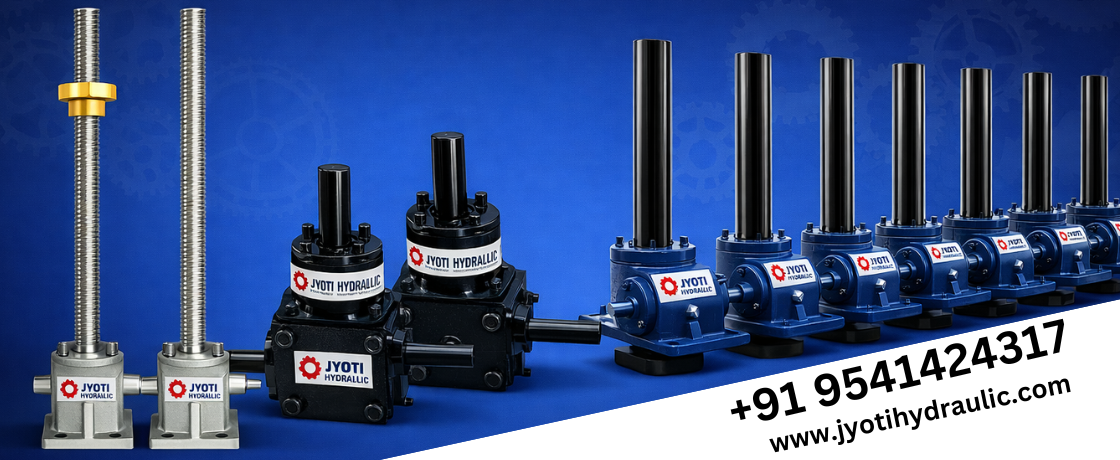
Jyoti Hydraulic understands that modern lifting and positioning systems are judged not only by load capacity, but also by precision, safety, service life, and compliance with recognized engineering standards. In industries where downtime is expensive and reliability is non-negotiable, a Worm Gear Screw Jack must be designed and selected with a clear understanding of DIN, ISO, and AGMA requirements. Whether the application involves synchronized lifting, heavy-duty machine adjustment, platform elevation, gate actuation, or industrial automation, standard-compliant screw jack systems offer measurable advantages in performance, interchangeability, and long-term durability.
Introduction
A Worm Gear Screw Jack is a mechanical actuator used to lift, lower, push, pull, align, or position loads with controlled linear motion. It converts rotary input into axial motion through a worm shaft and worm wheel arrangement, transmitting force to a lifting screw or translating nut. Because of its compact structure, self-locking potential, and ability to handle significant loads at low speeds, it remains one of the most trusted motion-control solutions in industrial engineering.
However, not all screw jacks are created equal. The true performance of a screw jack depends on material selection, machining accuracy, lubrication design, load rating methodology, and compliance with accepted engineering standards. This is why industrial buyers increasingly prefer working with experienced Worm Gear Screw Jack Manufacturers that understand not just product dimensions, but also the technical frameworks behind gear geometry, safety factors, and mechanical reliability.
For buyers evaluating Worm Gear Screw Jack Manufacturers in India or searching for a dependable Screw Jack Manufacturer in India, understanding DIN, ISO, and AGMA can make the difference between buying a standard catalog item and investing in a system engineered for real operating conditions.
Industry Overview
Mechanical screw jacks are widely used across sectors that demand dependable linear movement under load. They are valued for their ruggedness, straightforward operation, and compatibility with motors, gearboxes, handwheels, bevel gear systems, and automation controls.
Why the market continues to rely on worm gear screw jacks
Industrial users choose worm gear screw jacks because they offer:
- High load-handling capability in compact footprints
- Accurate lifting and positioning
- Low-speed, high-torque motion conversion
- Potential self-locking behavior in many applications
- Easy integration into single or multiple-jack systems
- Long service life with proper lubrication and maintenance
As manufacturing becomes more automated and safety-focused, customers are also expecting better documentation, traceability, and engineering validation. This is where compliance with DIN, ISO, and AGMA becomes especially relevant.
Understanding Standards: DIN, ISO & AGMA Explained Clearly
Standards provide a common engineering language. They help manufacturers, consultants, machine builders, and buyers align on quality expectations, tolerances, calculations, and safety principles.
What is DIN?
DIN stands for the German Institute for Standardization. DIN standards are highly respected in mechanical engineering, especially in Europe and among export-oriented manufacturers. In the context of screw jack systems, DIN-related practices often influence:
- Dimensional consistency
- Tolerance control
- Material specifications
- Surface finish requirements
- Fastener and assembly compatibility
- Mechanical design discipline
DIN-oriented engineering supports interchangeability and repeatable manufacturing quality. For a worm gear assembly, this means greater confidence in gear meshing, shaft alignment, housing integrity, and installation compatibility.
What is ISO?
ISO refers to the International Organization for Standardization. ISO standards establish globally accepted quality and process benchmarks across industries. For a Worm Gear Screw Jack, ISO influence may extend to:
- Quality management systems
- Manufacturing process control
- Inspection procedures
- Documentation and traceability
- Safety and product consistency
- Metric standardization and testing discipline
ISO-aligned manufacturing is especially valuable for OEMs and international buyers who require repeatable quality across batches and projects.
What is AGMA?
AGMA stands for the American Gear Manufacturers Association. AGMA standards are critical when evaluating gear-driven systems because they offer engineering methods for:
- Gear tooth design considerations
- Load capacity calculations
- Service factors
- Wear resistance assessment
- Bending and contact stress evaluation
- Lubrication and durability expectations
In a worm gear screw jack, the gear set is the heart of the mechanism. AGMA-based thinking helps determine whether the worm and worm wheel can reliably withstand operating loads, duty cycles, shock loads, and real-world service conditions.
Why these standards matter together
A multi-standard approach is often the most practical. In simple terms:
- DIN helps guide dimensional and mechanical discipline
- ISO strengthens quality consistency and process reliability
- AGMA supports robust gear design and load-performance evaluation
For industrial buyers, this combination improves confidence in product performance, lifecycle value, and technical credibility.
Technical Insights of Worm Gear Screw Jack
To choose the right product, it is important to understand how the system works internally.
Core working principle
A worm gear screw jack converts rotational motion into linear motion. When the worm shaft is rotated manually or through a motorized drive, it turns the worm wheel. This gear interaction drives the lifting screw or translating nut, creating linear movement.
Main components
1. Worm shaft
The input shaft, usually made from hardened alloy steel, transmits torque into the gear set.
2. Worm wheel
Typically made from phosphor bronze or other wear-resistant material, the worm wheel meshes with the worm shaft and provides torque multiplication.
3. Lifting screw
This is the load-bearing threaded element. Depending on the design, it either moves linearly or rotates while a translating nut moves.
4. Housing
Usually constructed from high-strength cast iron, ductile iron, or fabricated steel, the housing provides structural rigidity and protects internal components.
5. Bearings and seals
These support rotating parts, reduce friction, and help retain lubrication while preventing contamination ingress.
Types of screw jacks
Common variants include:
- Translating screw type for direct linear lift
- Rotating screw type where the screw rotates and the nut travels
- Keyed screw type to prevent screw rotation
- Ball screw jacks for higher efficiency and faster duty cycles
- Machine screw jacks for rugged, self-locking industrial lifting
Important technical selection factors
When selecting a Worm Gear Screw Jack, engineers should assess:
- Load capacity, including static and dynamic conditions
- Travel length
- Input torque requirement
- Screw speed and duty cycle
- Buckling risk for long screws
- Side load exposure
- Mounting orientation
- Ambient temperature and lubrication conditions
- Synchronization requirements for multi-point lifting
- Safety factor based on shock and usage severity
Practical engineering insight
One of the most common field mistakes is selecting a screw jack only by rated lifting tonnage. In actual industrial environments, the real requirement depends on eccentric loading, duty cycle, start-stop frequency, vibration, and alignment quality. A 5-ton rated screw jack may underperform if used in an application with heavy shock loading, side thrust, or poor base alignment. This is why experienced Worm Gear Screw Jack Manufacturers always consider the full application environment, not just the headline load figure.
Key Applications Across Industries
Worm gear screw jacks are used in a wide range of engineered systems.
Common industry applications
Material handling
- Lift tables
- Conveyor height adjustment
- Pallet transfer systems
- Loading platform leveling
Steel and heavy engineering
- Furnace door actuation
- Ladle gate movement
- Roll gap adjustment
- Maintenance platforms
Water and infrastructure
- Sluice gate opening systems
- Flood control gates
- Valve actuation
- Dam maintenance platforms
Packaging and automation
- Machine guarding movement
- Tool height adjustment
- Product positioning units
- Changeover systems
Renewable energy and special projects
- Solar panel tilt adjustment
- Structural positioning
- Testing rigs
- Custom synchronized lifting assemblies
For these sectors, working with specialized Worm Gear Screw Jack Manufacturers in India can offer a strong balance of engineering capability, customization, and cost efficiency.
Advantages & Benefits
A properly selected and standard-compliant worm gear screw jack provides more than lifting motion.
Key benefits
- Compact design: High force output from a relatively small footprint
- Controlled movement: Excellent for slow and precise adjustment
- Self-locking capability: Useful in many machine screw applications
- Customization flexibility: Easy to integrate with motors, encoders, bevel gearboxes, and shafts
- Durability: Long life when gear design, lubrication, and maintenance are correct
- Low maintenance: Simpler than many hydraulic or pneumatic alternatives for certain duties
- Synchronous operation: Multiple units can be linked mechanically for uniform lifting
- Application versatility: Works in push, pull, lift, tilt, and positioning tasks
Why compliance adds value
When a screw jack is engineered with DIN, ISO, and AGMA principles in mind, users benefit from:
- Better dimensional consistency
- Improved gear reliability
- More predictable service life
- Higher documentation quality
- Better compatibility with global engineering expectations
Buying Guide / Selection Tips
Choosing the right screw jack requires more than browsing a catalog.
1. Define the real load, not just the nominal load
Include dead load, live load, shock load, and possible uneven distribution.
2. Check travel and column stability
Long travel screws can face buckling risks. This must be calculated early in the design stage.
3. Review duty cycle carefully
Frequent operation generates heat and affects lubrication performance. Intermittent and continuous-duty applications should never be treated the same.
4. Consider speed versus efficiency
Machine screw jacks are strong and often self-locking, but they are generally slower and less efficient than ball screw alternatives.
5. Evaluate mounting and side loads
A screw jack should ideally handle axial loads. Side loading reduces performance and service life.
6. Ask about gear design standards
Reputable Worm Gear Screw Jack Manufacturers should be able to explain material pairings, safety factors, wear expectations, and the design philosophy behind the worm set.
7. Choose a knowledgeable supplier
A proven Screw Jack Manufacturer in India should provide:
- Load and travel guidance
- Technical selection support
- Customization options
- Material and quality details
- Installation and maintenance recommendations
Quick buyer checklist
Before finalizing a purchase, ask for:
- Rated load and safety factor
- Input torque data
- Lift speed details
- Duty cycle limitations
- Screw type and material
- Housing and gear material specifications
- Lubrication recommendations
- Mounting drawings
- Optional motorization and synchronization support
Future Trends & Innovations
The screw jack industry is evolving in response to automation, predictive maintenance, and demand for higher precision.
Emerging trends
Smarter integration
Screw jacks are increasingly being integrated with sensors, encoders, and PLC-controlled systems for real-time positioning and condition monitoring.
Improved materials
Advanced bronze alloys, better heat-treated steel, and enhanced sealing materials are improving wear resistance and lifecycle performance.
Modular customization
Modern customers want quick adaptation for travel length, gearbox input, motor flange options, anti-rotation systems, and corrosion-resistant finishes.
Better engineering validation
More buyers are demanding stronger calculation support, CAD integration, and application-specific recommendations rather than generic catalog selection.
Export-focused manufacturing
Leading Worm Gear Screw Jack Manufacturers in India are adopting more globally aligned engineering and documentation practices to serve OEMs and industrial buyers across international markets.
Conclusion
A Worm Gear Screw Jack may appear mechanically simple, but its performance depends on highly important design and manufacturing decisions. DIN, ISO, and AGMA are not just technical abbreviations; they represent a deeper framework for dimensional accuracy, gear reliability, quality consistency, and engineering confidence.
For industrial users, understanding these standards helps in selecting products that perform safely and consistently over time. For buyers comparing suppliers, the difference often lies in technical depth, not just price. The best Worm Gear Screw Jack Manufacturers understand application loads, duty cycles, alignment realities, and gear design principles. They deliver not just a component, but a dependable motion solution.
If you are evaluating Worm Gear Screw Jack Manufacturers in India or looking for a trusted Screw Jack Manufacturer in India, choose a partner that combines product quality with engineering expertise, practical application knowledge, and responsive technical support.
FAQ Section
1. What is a worm gear screw jack used for?
A worm gear screw jack is used to lift, lower, push, pull, align, or position loads in industrial systems. It is commonly used in material handling equipment, gates, platforms, machine adjustment systems, and automation assemblies.
2. Why are DIN, ISO, and AGMA important in worm gear screw jacks?
These standards help define manufacturing quality, dimensional consistency, gear design reliability, and process control. They improve confidence in product durability, performance, and interchangeability.
3. Are worm gear screw jacks self-locking?
Many machine screw worm gear screw jacks offer self-locking behavior under certain operating conditions. However, self-locking depends on screw design, lubrication, vibration, and load conditions, so application review is essential.
4. How do I choose the right worm gear screw jack capacity?
The correct capacity depends on actual load, shock factor, travel length, duty cycle, screw speed, mounting orientation, and possible side loads. Do not select based only on nominal load rating.
5. What is the difference between machine screw and ball screw jacks?
Machine screw jacks are rugged, cost-effective, and often self-locking, while ball screw jacks offer higher efficiency and faster travel but may require braking systems for load holding.
6. Why should I work with experienced worm gear screw jack manufacturers?
Experienced manufacturers provide application-based selection, better material and gear design choices, customization support, and guidance on installation, maintenance, and long-term reliability.
7. Are worm gear screw jack manufacturers in India suitable for global industrial requirements?
Yes, many established Worm Gear Screw Jack Manufacturers in India offer technically sound products, competitive pricing, and customization capabilities aligned with international industrial needs.
Contact Jyoti Hydraulic for Expert Support
Need the right Worm Gear Screw Jack for your application? Looking for reliable engineering support from experienced Worm Gear Screw Jack Manufacturers?
Contact Jyoti Hydraulic today to discuss your lifting, positioning, or motion-control requirement. Get practical guidance, technical consultation, and a solution tailored to your operating conditions.
Request a quotation, ask for expert consultation, or send your inquiry now:
📧 info@jyotihydraulic.com
📞 +91 9541424317


